IMSAFE in Practice: Fatigue, Food and Flying
By Pilot Prep
It is Friday night and the club aircraft is booked for 9 am. It has been a long week, there is a birthday dinner on, and the forecast looks great. Nothing about tomorrow feels like a safety decision yet.
It is one, though. Whether you are fit to fly is a decision nobody else sees you make, and IMSAFE is the walk-around for that one component:
- Illness: am I free of illness and symptoms?
- Medication: is everything I have taken safe to fly on?
- Stress: is my head in the cockpit?
- Alcohol: am I free of alcohol, drugs and their effects?
- Fatigue: am I rested and sleeping well?
- Eating: am I fed and watered?
Most student pilots can recite it. Far fewer use it in a way that changes a decision, so here is how to run it, and the mechanism behind the letters that catch people out.
Run it twice: the evening before and the morning of
Your medical certificate is a snapshot that can run for up to five years. Your actual fitness changes far faster, and on the day nobody checks it.
The trap is timing. Run IMSAFE only at the launch point and every answer arrives when it is hardest to act on, with the aircraft fuelled and your passenger in the car park pushing a marginal answer towards yes.
So run the check twice. The first pass is the evening before, while you can still fix things: get to bed early, eat properly, set your last-drink time or rearrange the booking. The second pass is on the morning of the flight, and confirms nothing has changed overnight.
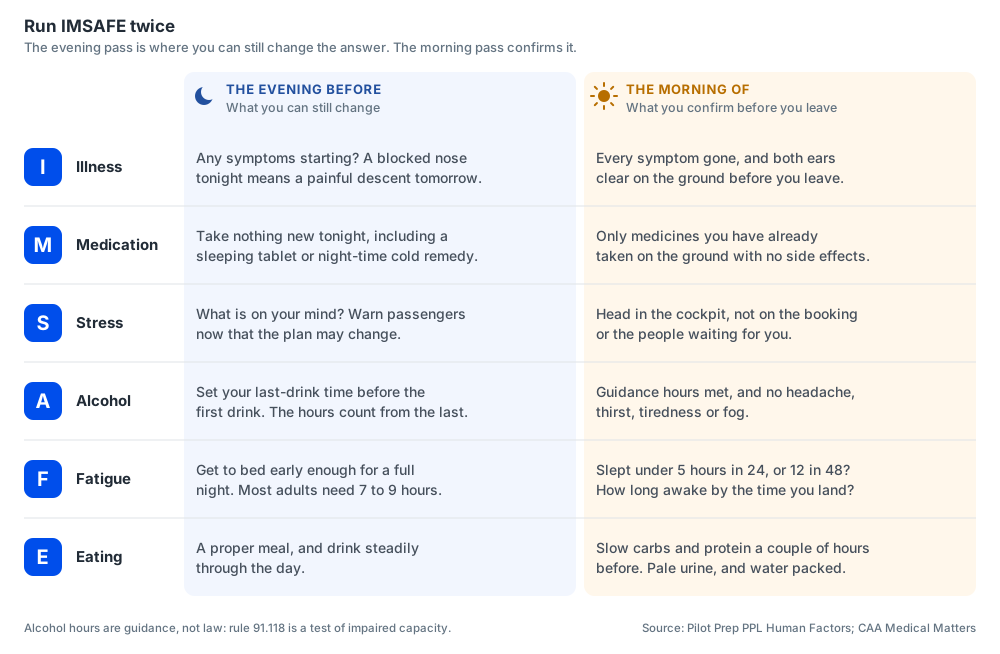
The evening pass is where you can still change the answer. The morning pass confirms it.
Fatigue: trust the facts, not the feeling
Fatigue is the letter where your own judgement is least reliable, because it degrades the brain doing the judging. As people become more fatigued their performance keeps falling, but their own rating of how impaired they are levels off. The more tired you are, the more you underestimate it.
It is also more serious than it feels, as research comparing sleep loss with alcohol (Dawson and Reid, 1997) showed.
About 17 hours awake impairs you roughly like a blood alcohol of 0.05%, and about 24 hours awake like 0.10%. There is no breath test for fatigue, so judge it by the numbers rather than by how you feel.
Two things set your alertness. Sleep pressure builds from the moment you wake, and only proper sleep resets it. Your body clock adds a daily rhythm on top, with a deep low roughly between 0300 and 0500 and a smaller dip in the early afternoon.
A pre-dawn departure after a short night stacks both, and most people cannot fall asleep earlier to make up for an early alarm.
Then there is sleep debt. Most healthy adults need seven to nine hours a night, and each short night carries its shortfall forward, so a run of them leaves you steadily more impaired.
So answer the F with facts. Our course teaches a four-step check:
- Count your sleep in the last 24 hours and the last 48. One rule of thumb used in fatigue risk management treats less than 5 hours in the previous 24, or less than 12 in the previous 48, as a clear warning sign.
- Count your hours awake to the time you will land, not the time you take off.
- Check the body clock for the small hours or the mid-afternoon dip.
- Believe the numbers over how you feel.
Caffeine does not change the answer. It hides the signal of sleep pressure for a few hours without repaying anything.
And a bad night with no illness is not a change in your medical condition, so there is nothing to report to the CAA. That does not make you fit.
Eating: the forgotten E
The E is the letter people skip, partly because it sounds trivial and partly because versions of the mnemonic disagree on what it stands for.
Some, including the FAA's in the United States, use Emotion, which overlaps heavily with Stress. The CAA's Medical Matters booklet uses Eating, summed up as fed, watered and ready to go, and so does our course. Your emotional state still gets checked, under S.
Eating earns its place because the brain runs almost entirely on glucose from the blood and stores very little of its own.
A fizzy drink or a pastry is absorbed fast. Blood sugar spikes, the body releases a large dose of insulin, and that insulin can overshoot so blood sugar dips below where it started an hour or two later. Low blood sugar brings poor concentration, irritability, shakiness and poor decisions, so gradually that most people blame tiredness.
Skip breakfast before an early flight and you meet that dip at the far end of the cross-country, just as you join an unfamiliar circuit. The fix is a moderate meal of slow carbohydrates and some protein a couple of hours before you fly, and never an empty stomach. A big, fatty meal fails the other way, bringing drowsiness while you digest it.
Water is the other half of the letter. Mental performance starts to fall at a loss of around 2 percent of body water, before most people feel especially thirsty.
So use a better signal than thirst: pale straw-coloured urine means you are well hydrated, and dark yellow means you are behind. Drink steadily through the day before and the morning of the flight, and carry water.
Caffeine belongs here too. A coffee before an early flight is reasonable, but too much brings jitters, and a heavy user who misses their usual cup can get a withdrawal headache mid-flight. Needing caffeine to feel normal is itself a sign of sleep debt.
Alcohol: the rule has no number
Drivers have a blood alcohol limit to stay under. Pilots do not, and that surprises people.
The rule is Civil Aviation Rule 91.118, Intoxicating liquor and drugs. No crew member acting in their official capacity may be intoxicated, or in a state where their capacity is impaired by having consumed or used "any intoxicant, sedative, narcotic, or stimulant drug or preparation".
Two things stand out. A crew member includes a student on a dual training flight, so the rule applies from your very first lesson. And the test is capacity: being intoxicated is only the first limb, and the second catches impairment of any degree, including a hangover that slows you down.
That is why there is no number: no fixed figure tracks impairment for everyone. A New Zealand standard drink holds 10 g of alcohol, and the liver clears roughly one an hour at a rate nothing speeds up, although body size, sex, food, health and genetics all shift it.
The effects also outlast the alcohol. After heavy drinking a hangover can last 24 to 48 hours or more.
The CAA's position follows from that. It says there is no measurable level of blood alcohol that is safe for aviation, and no legislated time period after drinking on which you can rely. A zero blood alcohol level is essential but not enough, because a hangover can still leave you unsafe.
You still need something to plan around. These figures are all guidance, not law.
Guidance, not law. The figure taught for the New Zealand PPL exam is at least 10 hours from your last drink (some authorities say 12), even after one or two drinks, and only once every after-effect has gone. The CAA's Medical Matters booklet is more conservative: a minimum of 12 hours after low-level drinking, 24 hours after more than one or two standard drinks, and much longer, such as 48 hours, after heavy drinking.
Club and operator bottle-to-throttle policies, commonly 8 to 12 hours and 24 at some operators, are minimums for that organisation, never permission to fly. If the headache and dry mouth are still there when the hours are up, you are still not fit.
So decide before the first drink, and count the hours from the last one. Alcohol impairs the very judgement you would use to decide you are fine.
Illness and medication
The I and the M belong together, because the medicine usually arrives with an illness, and either can ground you.
A head cold looks minor until you think about pressure. It swells the passages linking your middle ears and sinuses to your nose. Air escapes on the climb, but on the descent the swollen lining acts like a one-way flap, and the pain can incapacitate you on the approach, the busiest part of the flight.
So wait until every symptom, including a blocked nose, has gone, then check on the ground that your ears clear when you gently blow against a pinched nose. If they will not clear on the ground, they will not clear on the descent.
Stomach bugs are worse still. Food poisoning can incapacitate you within minutes, in an aircraft with no toilet and nobody to take over.
Rule 91.118 also covers sedatives and stimulants, which means plenty of what is on the supermarket shelf. Sedating antihistamines in night-time cold and flu tablets commonly cause drowsiness lasting 8 to 12 hours. Decongestant tablets can raise heart rate and blood pressure, and codeine is not compatible with flying.
The CAA's Medical Matters booklet is specific about hay fever. It names three permitted antihistamines (loratadine, desloratadine and fexofenadine), recommends trying them on the ground first, ideally on three or more occasions, and says all other antihistamines, including the common cetirizine, should not be taken within 48 hours before flying.
Medicine can also mask the symptom that should have kept you on the ground, then wear off part way through the flight. The working rule is that no drug is safe for flying the first time you take it. Trial anything new on the ground well before you need to fly, tell any prescribing doctor you are a pilot, and run any prescription past your aviation medical examiner.
Some changes go beyond a flying-day decision. Under Schedule 2, clause 8 of the Civil Aviation Act 2023, if you know or reasonably suspect a change in your medical condition that may interfere with safe flying, you must stop exercising your licence privileges and advise the Director as soon as practicable. A CAA general direction takes short-lived conditions, such as an ordinary cold that clears completely, out of the reporting duty, but never out of the duty not to fly.
Chest pain, a faint, any loss of consciousness or a sudden severe headache are a conversation with your aviation medical examiner before the next flight, not an IMSAFE judgement call. None of this is personal medical advice. If you are wondering whether to ask your examiner, ask, and do not fly while you wait.
When several answers are "probably fine"
The biggest threat to IMSAFE is not a clear no. It is the quiet "I'm probably okay".
The dangerous mornings are the ones where every answer is marginal: a short night, a stressful week, coffee instead of breakfast, a sniffle you have decided is hay fever. Each letter passes on its own, and together they do not.
The factors compound rather than simply add up. A stressed pilot sleeps badly, drinks more coffee and eats less, and a pilot with a cold takes a remedy that makes them drowsy. Mild stress alone might leave you flying adequately, but add a short night, mild dehydration and a cold tablet, and the combined impairment is far worse than any one of them suggests.
It is the error chain that accident investigators keep finding. A pilot sleeps badly, rushes the pre-flight and misses a fuel error, and a stronger headwind than forecast turns that into a fuel worry just as the weather closes in. The tired start was the first link.
Many instructors teach a two-strike rule to take that judgement out of the moment. If two significant things have already gone against you, stop and reassess rather than press on towards a third. Two marginal IMSAFE answers can be your two strikes before you have left home.
Acting on it does not always mean cancelling, because fitness is not a fixed bar. A slightly tired pilot may be fit for twenty minutes of circuits in calm air, and not for a two-hour solo crossing of the Southern Alps ahead of a front.
So delay, fly something shorter and simpler, or tighten your personal limits. A 12 knot crosswind limit when rested might sensibly become 8 knots at the end of a long, tiring day.
One habit helps more than any other. Ask each question as if a friend were asking it about you, and act on the answer you would give them.
The bottom line
IMSAFE is the only pre-flight inspection of the one component nobody else checks, and it works only if you are willing to ground yourself.
Run it the evening before, while you can still change the answer, and confirm it in the morning. Judge fatigue by the numbers. Eat and drink as though the second half of the flight depends on it, because it does. Treat rule 91.118 as a test of capacity, not a countdown. And when several answers come back as "probably fine", add them up.
Try some real exam questions on fitness to fly, alcohol and fatigue, free and without signing up, and see how much of this you can already answer. For the whole picture, our PPL Human Factors course teaches the mechanism behind every rule in this post, so you can use it in the cockpit and pass the exam.
Sources and further reading
- CAA, Medical Matters, Good Aviation Practice booklet
- CAA, Alcohol consumption and medical aviation safety, clinical guideline
- CAA, Medical Information Sheet MIS 014, Alcohol consumption and medical aviation safety
- CAA, Part 91 General Operating and Flight Rules, including rule 91.118
- CAA Medical Manual, Change in medical condition
- Dawson D. and Reid K., Fatigue, alcohol and performance impairment, Nature 388, 1997