The Biggest Review of NZ Pilot Licensing in Decades Has Started
By Pilot Prep

The rules that decide how New Zealand licenses and trains pilots are being rewritten, and the work started this quarter.
Part 61 is the rule part that governs pilot licences and ratings. It sets out what a PPL is, what a CPL requires, how instructors and examiners are approved, and what a training syllabus has to contain. The CAA has now opened a complete review of it, and describes it as the largest project in its entire Rules Update Programme.
Nothing has been decided. That is exactly why it is worth paying attention now rather than in two years when the consultation is closed.
Here is what is actually happening, what is genuinely on the table, and what it means if you are part-way through a licence today.
First, what has already changed
It is easy to lose the review inside a larger programme that has been quietly shipping things all year, so it helps to separate the two.
The Rules Update Programme was announced by the Acting Minister of Transport in April 2026. Its stated aims are to modernise New Zealand's civil aviation rules, increase alignment with international standards, and make the rule framework more responsive to the sector. It covers dozens of projects across almost every rule part.
Several have already landed.
Part 91, the general operating and flight rules, came into force in amended form on 12 June 2026. It inserted a new rule 91.17 and replaced a set of existing rules covering emergency equipment standards and related requirements.
On 31 August 2026, Part 1 Amendment 3 and Part 139 Amendment 2 came into effect, along with a new transport instrument covering arresting systems and a consolidated advisory circular on runway end safety areas.
Separately, from 1 July 2026 laminated CAA medical certificates were replaced by electronic ones, and the CAA published an FAQ page on the change in early July.
None of that is the Part 61 review. All of it is the same programme, moving.
The Part 61 review, and why it is the big one
The CAA's own project summary sets the scope. The review will look at Part 61 to improve training, licensing and progression, particularly for commercial, private and specialist operations, and to align New Zealand with ICAO and comparable countries.
Five areas are named specifically:
- Modernising training syllabi
- Creating clearer and more flexible pathways for pilot qualifications
- Reviewing the rules about instructors and examiners
- Clarifying rules for remote and uncrewed aircraft operators, including drones
- Considering licensing and training needs for emerging technologies such as powered lift and electric vertical take-off and landing aircraft
Read that list again with your own training in mind. The first two items are the syllabus you are studying and the route you take through it. The third is the people who teach and test you.
The Part 61 review started in Q3 2026 and is the largest project in the CAA's Rules Update Programme. Its scope explicitly includes modernising training syllabi and creating clearer, more flexible qualification pathways.
In July 2026 the CAA appointed Captain David Morgan as Independent Industry Advisor to the project. His role, set out in published terms of reference, is to act as an external industry facilitator during the discovery phase, helping the CAA and the Ministry for Cities, Environment, Regions and Transport gather and synthesise input from the sector.
Appointing an external facilitator specifically for discovery is a reasonable signal that the CAA expects the input stage to matter, and that it wants more than the usual submissions from the usual organisations.
Where it sits in the programme
The review is one project among many, and the ones around it matter too.
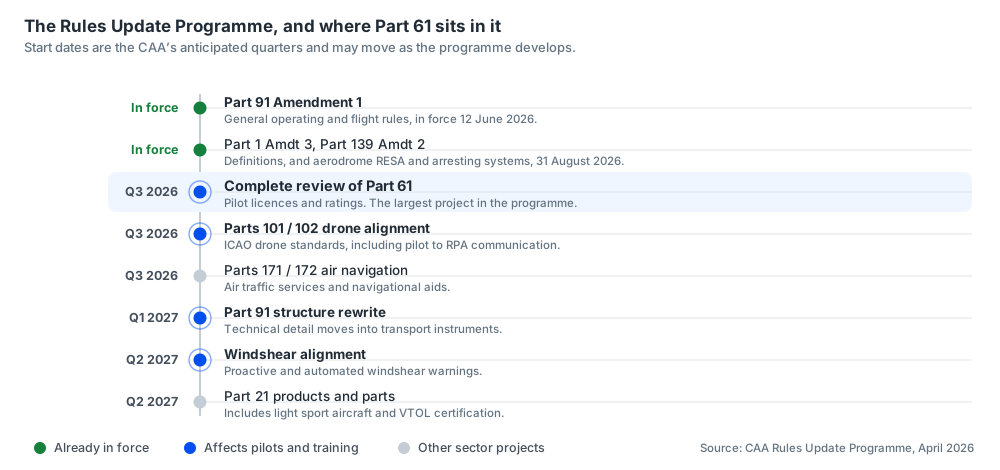
Start dates are the CAA's anticipated quarters and are expected to move as the programme develops.
| Project | Anticipated start | Why it matters to a pilot |
|---|---|---|
| Complete review of Part 61 | Q3 2026 | Licences, ratings, training syllabi, instructors and examiners |
| Parts 101 and 102 drone alignment | Q3 2026 | ICAO drone standards, including communication between pilots and remotely piloted aircraft |
| Parts 171 and 172 air navigation | Q3 2026 | Air traffic services and navigational aids |
| Part 91 general structure rewrite | Q1 2027 | Technical detail moves into transport instruments the Director can update |
| ICAO alignment on windshear | Q2 2027 | More proactive and automated windshear warnings |
| Part 21 products and parts | Q2 2027 | Light sport aircraft and VTOL certification |
There is also an ICAO Safety Audit project, currently in discovery, covering flight training, medical certification and air operations. It is aimed at locating aircraft in distress, safety requirements for single-engine aircraft, and standards for safety equipment such as emergency beacons.
Two of those projects deserve a second look if you fly light aircraft. The Part 91 structure rewrite would move a lot of technical detail out of the rule itself and into transport instruments that the Director of Civil Aviation can update, rather than the Minister. That changes how quickly operating requirements can change. And the drone alignment work lands squarely on the mixed-traffic problem the CAA has been writing about all year, including in its September report on airborne conflict in uncontrolled Class G airspace.
Programme announced
Part 91 amendment in force
Part 61 review begins
Discovery and policy investigation open on the largest project in the programme. Captain David Morgan is appointed Independent Industry Advisor on 6 July.
Part 1 and Part 139 amendments in force
Part 91 structure rewrite
What is on the table, and what is not
This is where care is needed, because a review at discovery stage attracts a lot of confident speculation.
What the CAA has committed to is a scope, a start quarter and a process. It has not proposed a single specific change to Part 61. There is no draft rule, no consultation document on licence structure, and no announced change to the six PPL theory subjects or the ASPEQ examinations.
Anyone telling you the exams are about to change, or that a new licence category is coming, is guessing. The published scope is broad enough to permit a great deal, and broad enough to permit very little.
What is reasonable to expect from the stated scope:
- Attention to how a pilot progresses from PPL to CPL and beyond, since "progression" and "clearer and more flexible pathways" are called out by name
- Some modernisation of training syllabi, since that is the first item on the CAA's own list
- New or adapted licensing provisions for powered lift and eVTOL, because the current framework has nowhere sensible to put them
- Changes to the instructor and examiner framework, which the CAA has flagged as an area of difficulty
The project will begin with discovery and policy investigation phases, including problem definition, and the CAA notes that scope may be adjusted in response to what it learns. In other words the shape of this is not fixed even now.
What it means if you are training right now
Very little, immediately, and that is the honest answer.
Rule reviews of this size run for years. Discovery comes first, then policy work, then a draft rule, then public consultation, then ministerial signoff, then an effective date, and usually transitional arrangements after that. The Part 61 review started this quarter. A student starting a PPL today will almost certainly finish it under the current rules.
So keep studying the current syllabus, because it is the one you will be examined against. The PPL theory exams remain the six ASPEQ subjects, sat at ASPEQ testing centres, with a 70 percent pass mark.
Two things are worth doing anyway.
Watch the consultation rather than the rumours. The CAA publishes rule consultations on its website and runs a notification service that emails you when rules, airworthiness material and other topics are updated. That is the actual signal, and it costs nothing.
And if you have an opinion about training pathways, instructor supply or how the licence structure works in practice, discovery is the phase where it can still shape the problem definition. Once a draft rule exists, submissions are arguing about wording. Right now they are arguing about what the problem is, which is a far more useful conversation to be in.
The bottom line
The CAA has opened the biggest review of New Zealand pilot licensing in decades, appointed an independent industry advisor to run the listening phase, and published a scope that reaches the training syllabus, the qualification pathway and the instructor framework.
It has not yet proposed anything. Treat any specific claim about what will change as speculation until a consultation document exists.
If you are in training, nothing changes today. Study the syllabus in front of you. But this is one of the rare moments where the rules that will govern the rest of your flying career are genuinely open, and the people who turn up during discovery tend to get a better outcome than the ones who turn up to complain about the draft.
Sources and further reading
Frequently asked questions
What is the CAA Part 61 review?
It is a complete review of Civil Aviation Rule Part 61, which governs pilot licences and ratings in New Zealand. The CAA describes it as the largest project in its Rules Update Programme. Its scope covers modernising training syllabi, creating clearer and more flexible qualification pathways, reviewing the instructor and examiner rules, clarifying rules for remote and uncrewed aircraft operators, and licensing for emerging technologies such as powered lift and eVTOL aircraft.
When did the Part 61 review start?
Q3 2026. In July 2026 the CAA appointed Captain David Morgan as Independent Industry Advisor to facilitate sector input during the project's discovery phase. The project begins with discovery and policy investigation, and the CAA notes that scope may be adjusted as the work develops.
Will the PPL theory exams change?
Nothing has been proposed. The published scope includes modernising training syllabi, which could eventually touch the exams, but there is no draft rule, no consultation document on licence structure, and no announced change to the six PPL theory subjects or the ASPEQ examinations. Any specific claim about what will change is speculation until a consultation document exists.
Does the Part 61 review affect me if I am training now?
Not immediately. Reviews of this size run through discovery, policy work, a draft rule, public consultation, ministerial signoff and then an effective date, usually with transitional arrangements. A student starting a PPL today will almost certainly finish it under the current rules, so study the current syllabus. You can follow the actual progress through the CAA's rule consultations and its notification service.
What else in the Rules Update Programme has already changed?
Part 91, the general operating and flight rules, came into force in amended form on 12 June 2026. Part 1 Amendment 3 and Part 139 Amendment 2 took effect on 31 August 2026, along with a transport instrument on arresting systems and a consolidated advisory circular on runway end safety areas. Separately, laminated CAA medical certificates were replaced by electronic ones from 1 July 2026.