The CAA Just Published the Numbers on New Zealand Near Misses
By Pilot Prep
In September 2026 the CAA published the numbers behind New Zealand's near misses in uncontrolled airspace, and they say something uncomfortable.
The system is very good at recovery. It is much less good at prevention.
Between 1 January 2025 and 31 May 2026 there were 112 reported airborne conflicts in Class G airspace. Most of them ended safely because somebody eventually saw something. Not because the conflict was prevented from developing in the first place.
That distinction is the whole report, and it is worth understanding properly whether you are twenty hours into a PPL or two thousand hours into a career.
What the report actually found
The headline number is 112 occurrences over seventeen months. That is roughly one reported conflict every five days.
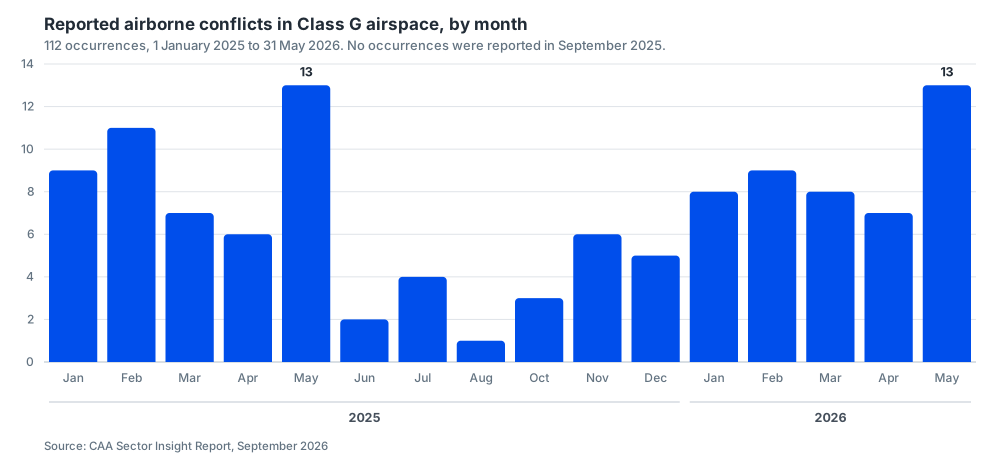
Reported occurrences by month. The CAA notes the May and February peaks track periods of higher general aviation and training activity rather than any single location.
Of those 112, the CAA classified 107 as airspace incidents and 5 as aviation related concerns. More usefully for a pilot, they sorted them by how close the thing came to going badly wrong.
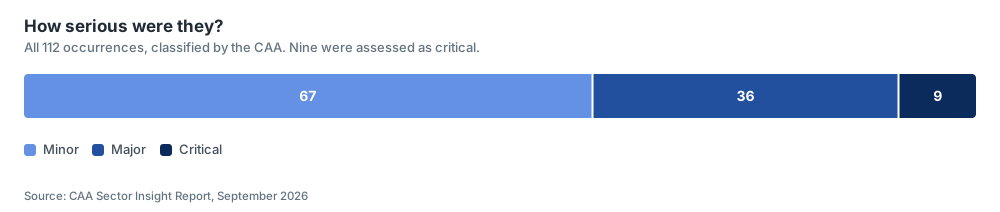
Nine of the 112 were assessed as critical.
Nine critical events in seventeen months, in a country with a small general aviation fleet, is not a rounding error. It is roughly one every eight weeks.
The split by location matters just as much. Of the reported occurrences, 86 happened close to an aerodrome and 26 were enroute. That is 77 percent of the total inside the bit of the flight you probably think of as routine.
Most involved two light aeroplanes, 66 occurrences or 59 percent of the total. The next most common pairing was an aeroplane and a helicopter, at 19 occurrences. Ten events involved more than two aircraft, and one of them involved eight.
112 reported airborne conflicts in Class G airspace between January 2025 and May 2026. 77 percent happened close to an aerodrome. Nine were assessed as critical.
Busy is not the same as dangerous
The raw location counts look damning for a handful of places. Whanganui recorded 18, Rangiora 10, Feilding 8, and Ardmore, North Shore and Kapiti 6 each.
Read on its own, that list is misleading. A busy training aerodrome will generate more reports simply because more aeroplanes fly there, and because places with a strong reporting culture report more. The CAA says this explicitly.
The useful figure is the rate.
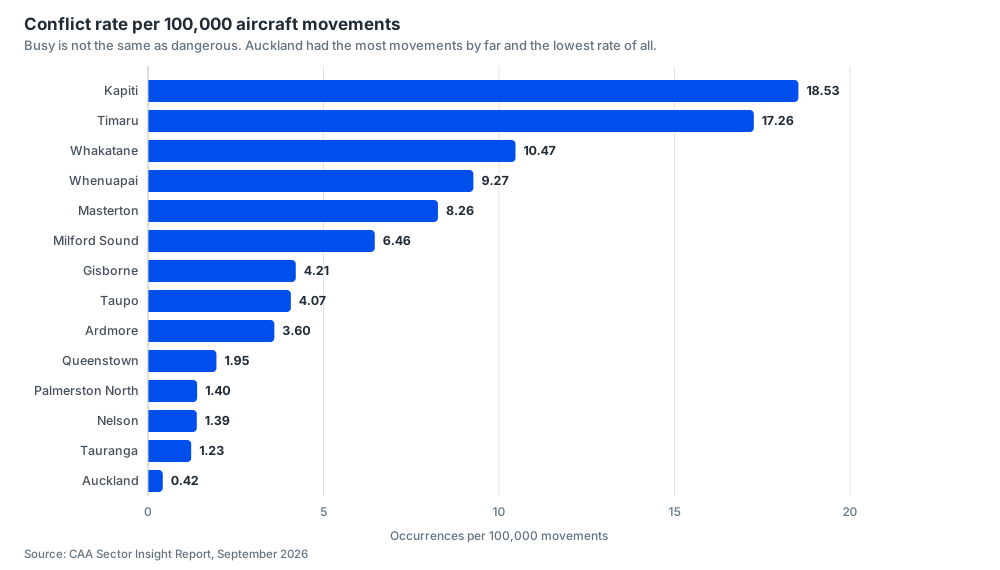
The same events, divided by traffic volume. The ordering changes completely.
Auckland handled 236,013 movements and reported one conflict, a rate of 0.42 per 100,000. Kapiti handled 32,383 movements and reported six, a rate of 18.53. That is more than forty times Auckland's rate at roughly one seventh of the traffic.
There is no mystery in that. Auckland is Class C with a controller separating traffic. Kapiti is uncontrolled, mixed, and busy. The difference is not the pilots, it is whether anyone else is holding the picture for you.
Which is the real point of the report. In Class G nobody is holding the picture for you, and the aerodromes where that bites hardest are the small busy ones rather than the big ones.
If any of that airspace vocabulary is doing more work than you would like, start with our guide to New Zealand airspace classes and reading a VNC and come back.
Where it goes wrong in the circuit
With 77 percent of conflicts happening near an aerodrome, the circuit is where this is worth studying in detail. The report lists four recurring scenarios, and they are strikingly specific.
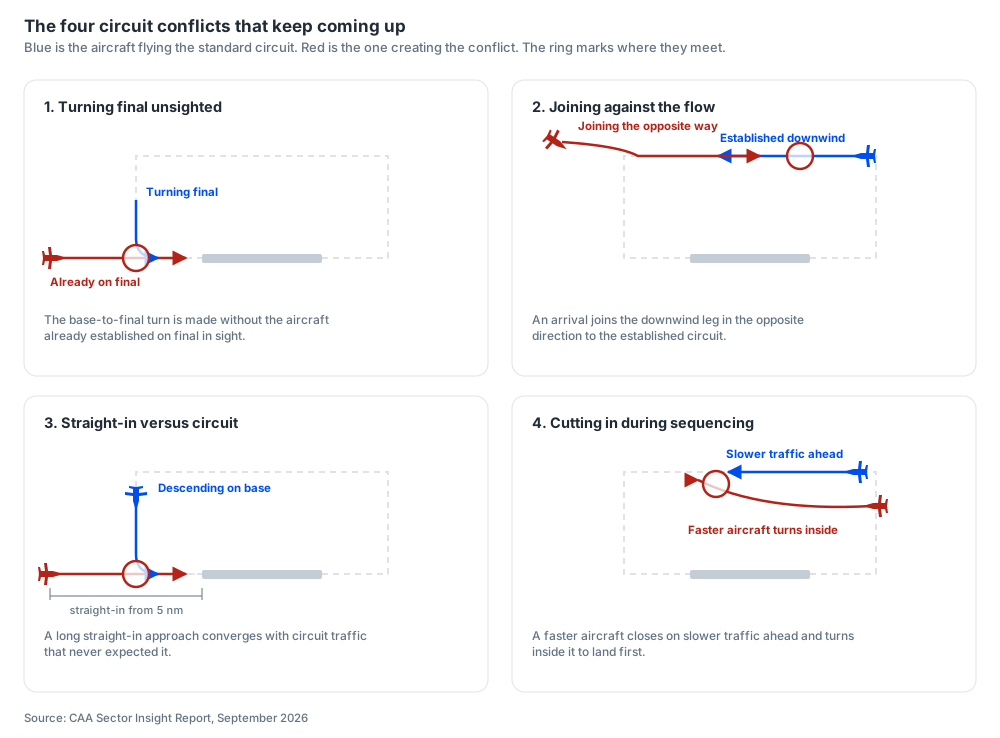
Each conflict lands in a different part of the circuit, which is why a single fix does not cover them all.
What ties them together is predictability. None of these are wild flying. The CAA's point is that the variations involved are small and almost never deliberate, and that this is precisely why they bite. Everyone else in the circuit is planning around the assumption that you will do the expected thing, so the moment you do not, their plan is wrong and they have no way of knowing it.
The standard overhead join exists precisely to make you predictable. Work through it here until the sequence and the heights are automatic rather than recalled.
Loading simulation
The part your eyes cannot fix
The most quietly alarming thread in the CAA's 2026 work is how often separation survived only because somebody sighted something late.
There is a reason for that, and it is not a lack of effort.
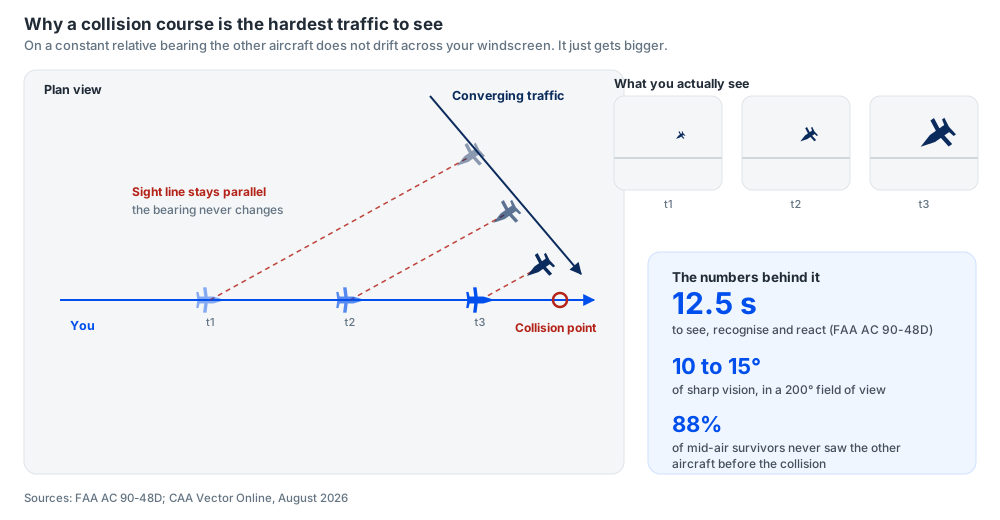
An aircraft on a genuine collision course holds a constant relative bearing, so it does not move across your windscreen. It only grows.
Movement is what the eye is good at detecting. A collision course removes the movement. The aircraft that is going to hit you is the one sitting perfectly still in your windscreen, getting very slightly larger, until it is not slight any more.
Layer the rest of the human hardware on top. You have roughly 200 degrees of field of view but only 10 to 15 degrees of sharp vision. Refocusing between the instruments and the far distance takes one to two seconds. In empty sky with nothing to focus on, your eyes relax to a few feet in front of the windscreen and stop resolving distant objects at all.
FAA guidance allows 12.5 seconds to see, recognise, decide and react. Startle eats some of that. A fast closing speed eats more.
The number that should settle the argument comes from FAA interviews with 658 pilots who survived a mid-air collision. Eighty-eight percent of them never saw the other aircraft.
Loading simulation
Sharp vision is narrower than almost anyone guesses before they see it demonstrated. This one is worth a minute.
Loading simulation
The practical consequence is that a long fixated stare out the front is not a lookout. A lookout is a systematic scan in short sectored movements, with a deliberate pause in each sector to let the eyes actually focus, and active manoeuvring to clear the blind spots your wings and door pillars create.
The radio half of the problem
Communication breakdowns show up in almost every occurrence type in the report. Missing calls, inaccurate position reports, simultaneous transmissions, and aircraft simply on the wrong frequency.
The CAA's separate analysis of 207 enroute close calls found that in 50 percent of them the pilots reported hearing no calls at all from the other aircraft. A further 15 percent involved poor radio practice, meaning insufficient calls, late calls, barely readable calls, or a position that was reported wrongly.
So in roughly two thirds of enroute close calls the radio did not do its job.
That reframes what a position report is for. It is not a formality and it is not for the controller you do not have. It is the only tool that puts you in someone else's traffic picture before either of you can possibly see the other.
Electronic traffic awareness helps, and the report credits it with catching conflicts that communication had already missed. It also finds the obvious limits, namely aircraft with no transponder or ADS-B, equipment switched off, and alerts that arrive late. Leave the transponder on ALT and treat what it shows you as one layer, not the answer.
The seven things that keep showing up
The CAA groups the whole dataset into seven risk drivers. This is the table worth keeping.
| Risk driver | Where it shows up |
|---|---|
| Communication breakdowns | Most occurrences |
| Circuit conflicts | High-traffic uncontrolled aerodromes |
| Mixed airspace interactions | All operation types |
| Procedural deviations | Joins, circuit operations, departures |
| Situational awareness limitations | Visual lookout and traffic perception |
| Technology gaps | Transponder and ADS-B limitations |
| Training environments | High-traffic uncontrolled aerodromes |
Notice that training environments appear as a risk driver in their own right. The CAA is careful about how it frames this. Instruction adds complexity and workload, and student performance is variable, but instructors also intervene and resolve a great many developing conflicts. Training is both an exposure and a safeguard.
If you are a student, that cuts one way in particular. The habits you build in the circuit now are the ones you will still have at five hundred hours, when nobody is sitting beside you to catch the thing you did not see.
What this actually changes about how you fly
None of this is new information. All of it is the syllabus. What the report adds is evidence about which bits of the syllabus keep failing in practice.
Four things fall out of it.
Be predictable, because other pilots are planning around the assumption that you will be. A non-standard join is not just your problem, it removes everyone else's ability to anticipate you.
Make the call before you need it, not once the conflict exists. Half of enroute close calls involved somebody hearing nothing at all.
Scan in sectors with pauses, and manoeuvre to clear your blind spots during climbs and turns. A constant stare is not a lookout, and the aircraft on a collision course is the one not moving.
Use every layer and trust none of them alone. Radio, lookout and electronic traffic awareness each fail in different ways, and the occurrences where all three were thin are the ones that became critical.
The bottom line
The CAA's own conclusion is the one to hold onto. Class G separation rests on three things, namely talking, looking and judgement. All three work. The problem the data exposes is timing, because they are, in the report's words, "often applied late."
A system that is strong in recovery and inconsistent at prevention is a system running on luck at the margins. Ninety-nine times out of a hundred somebody sees something in time. The 112 reports are the times it got close enough to be worth writing down.
You cannot fix the airspace class you fly in. You can be the aircraft that was predictable, that made the call, and that had already looked in the place the other one came from.
Try some real exam questions on airspace, circuits and human factors, free and without signing up, and see how much of this you can already answer. Airspace and the rules of the air are taught in depth in our NZ PPL Air Law course, and lookout and collision avoidance in our NZ PPL Human Factors course.
Sources and further reading
- CAA, Aviation Safety Insights Sector Insight Report: Airborne conflict in uncontrolled Class G airspace, September 2026
- CAA Vector Online, The 'big sky' is getting smaller, 3 August 2026
- CAA Safety Message, Airborne conflict in uncontrolled Class G airspace, July 2026
- FAA Advisory Circular 90-48D, Pilots' role in collision avoidance
Frequently asked questions
How many airborne conflicts were reported in New Zealand Class G airspace?
The CAA recorded 112 reported airborne conflicts in Class G airspace between 1 January 2025 and 31 May 2026. Of those, 67 were classified as minor, 36 as major and 9 as critical. 107 were airspace incidents and 5 were aviation related concerns.
Where do most Class G conflicts happen?
Close to aerodromes. 86 of the 112 occurrences, or 77 percent, happened near an aerodrome rather than enroute. The circuit is where the risk concentrates, and the CAA lists turning final without sighting traffic, joining against the circuit flow, straight-in approaches conflicting with circuit traffic, and cutting inside the sequence as the recurring scenarios.
Which New Zealand aerodrome has the highest rate of airborne conflicts?
By rate per 100,000 aircraft movements, Kapiti was highest at 18.53, followed by Timaru at 17.26 and Whakatane at 10.47. Auckland had the lowest rate at 0.42 despite handling 236,013 movements, far more than anywhere else. Raw counts favour big aerodromes, so the rate is the fairer comparison.
Why is an aircraft on a collision course so hard to see?
Because it holds a constant relative bearing, so it does not move across your windscreen. It only grows larger. Your eye detects movement well and a collision course removes the movement. You also have only 10 to 15 degrees of sharp vision within a roughly 200 degree field of view, and FAA guidance allows just 12.5 seconds to see, recognise and react. In FAA interviews with 658 pilots who survived a mid-air collision, 88 percent never saw the other aircraft.
Do radio calls actually prevent these conflicts?
Only when they are made and heard. The CAA's analysis of 207 enroute close calls found that in 50 percent of them the pilots reported hearing no calls at all from the other aircraft, and a further 15 percent involved poor radio practice such as late calls, insufficient calls or a misreported position. Communication breakdowns appear in most occurrence types in the report.