NZ Airspace Classes Explained: C, D, G and How to Read a VNC
By Pilot Prep
ICAO defines seven classes of airspace, A through G. New Zealand uses four of them, and only three of those will ever matter to you as a VFR pilot.
That is the single most useful thing to know before you start, because most airspace material is written for the whole alphabet and buries the bit you actually need.
This is a working guide to the airspace you will fly in, the shapes it takes, the special use zones that sit inside it, and how to read all of it off a VFR navigation chart before you get anywhere near the boundary.
Only three classes matter here
AIP ENR 1.4 states that Classes B, E and F are not currently used in New Zealand. Class A exists, but only as high-level oceanic airspace in the Auckland Oceanic area, far above anything you will fly VFR.
What is left is C, D and G.
| Class | Controlled? | VFR permitted | Clearance to enter | Who separates you |
|---|---|---|---|---|
| A | Yes | No, IFR only | Yes | ATC separates everyone. Oceanic only in NZ |
| C | Yes | Yes | Yes | ATC separates IFR from IFR and IFR from VFR. VFR gets traffic information about other VFR |
| D | Yes | Yes | Yes | ATC separates IFR from IFR. VFR gets traffic information only, and stays responsible for seeing and avoiding other VFR |
| G | No | Yes | No | Nobody. Flight information service on request, separation entirely yours |
Two questions sort the whole alphabet. Is the airspace controlled, meaning does ATC actively separate aircraft and require a clearance? And how restrictive is it, with Class A the most restrictive and the restriction relaxing as you move toward Class G?
There is one boundary rule from ENR 1.4 worth committing to memory. Where two classes adjoin one above the other, an aircraft at the common level complies with the requirements of, and receives the service of, the less restrictive class. So if Class C sits directly on top of Class D, a flight exactly on the dividing level is treated as being in the Class D airspace.
Loading simulation
In New Zealand, VFR airspace is Class C, Class D and Class G. C and D are controlled and need an ATC clearance to enter. G is uncontrolled and needs no clearance and no radio. Classes B, E and F are not used here.
The difference between C and D is subtle and examinable. In Class C, ATC keeps you apart from IFR traffic. In Class D, ATC only tells you about the other traffic, and keeping clear of it is your job. Knowing whether somebody is watching your back changes how hard you should be looking out the window.
In Class G nobody is watching it at all, which is why the CAA's September 2026 report on airborne conflict in uncontrolled airspace makes the reading it does.
The shapes: control zones and control areas
Classes are categories. The shapes you actually see on a chart are control zones and control areas, both designated under CAR Part 71, and the difference between them is simply where they start.
A control zone (CTR) is controlled airspace extending upwards from the surface of the earth to a specified limit. The key word is surface. A CTR reaches the ground, which is why you cannot taxi onto the manoeuvring area or get airborne at a controlled aerodrome without a clearance. A New Zealand CTR is Class C or Class D, typically running from SFC to a top in feet AMSL.
A control area (CTA) is controlled airspace extending upwards from a specified limit above the earth. It does not reach the ground. It has a floor aloft and a ceiling above that, protecting aircraft climbing, descending and transiting at height while leaving the air underneath free.
That is what produces the stepped shape everyone describes as an upside-down wedding cake.
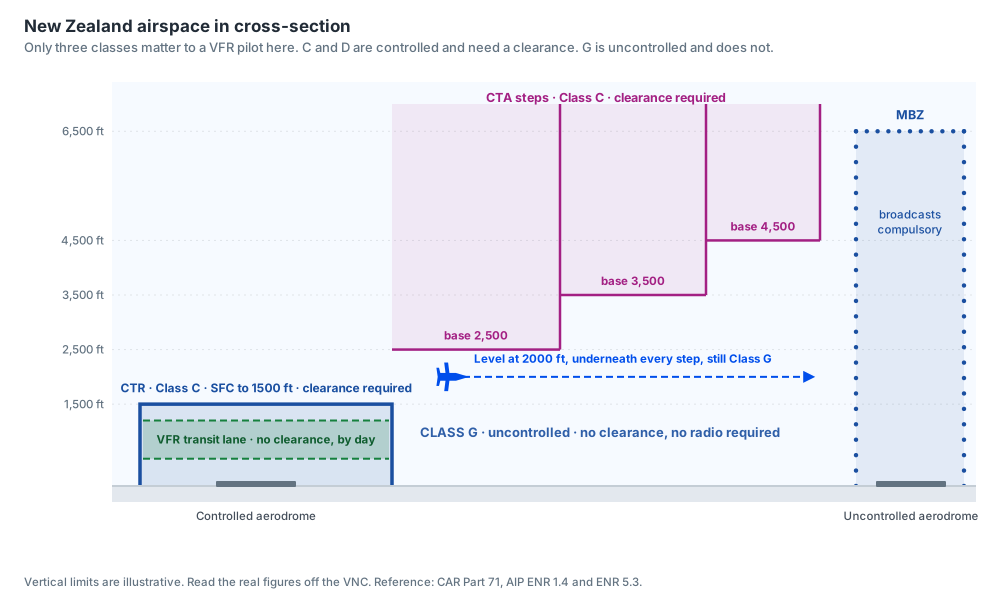
Close to the aerodrome the controlled airspace comes down to the surface. Further out the steps climb, leaving Class G underneath for you to route through.
Loading simulation
The practical consequence is the one the diagram shows. An aircraft flying level at 2000 ft passes underneath a 2500 ft step, a 3500 ft step and a 4500 ft step without ever entering controlled airspace or speaking to anyone. Routeing under the steps is a completely normal way to get past a busy aerodrome.
Getting through, not just around
Two features exist specifically so that controlled airspace does not wall off the busy parts of the country.
A VFR transit lane is the clever one. AIP ENR 5.5 describes it as part of a CTR or CTA that is released as Class G airspace, during daylight hours only, so VFR aircraft can transit through airspace not normally used by IFR traffic. While a transit lane is active, you may enter and operate in it without a clearance and without reference to ATC.
The freedom has tight edges. Day only. Defined lateral boundaries and a specified vertical limit, for example surface to 1500 ft. The moment you climb above the top or drift outside the sides, you are back in controlled airspace without a clearance. Transit lanes carry a T designation on the chart.
A general aviation area (GAA) is a volume set aside for general aviation work, usually next to controlled airspace. CAR 91.139 says you must not operate in one at night or using NVIS, and by day only if the area is active. There are three ways it becomes active, and which one applies is published in the Air Navigation Register:
- Permanently active during the day, so you simply use it
- Active by ATC approval, so you obtain approval from the responsible ATC unit and comply with any request to vacate
- Active by notification, so you notify the responsible ATC unit in advance and the unit confirms the area is active
The trap with a transit lane is the box. The trap with a GAA is assuming it is open.
Where the radio becomes compulsory
Uncontrolled does not always mean unregulated, and this is the distinction examiners love.
A mandatory broadcast zone (MBZ) is established under AIP ENR 5.3 to give increased protection in uncontrolled airspace where high-density or special operations occur. There is no controller separating traffic, so the next best thing is making sure everyone can hear everyone else.
CAR 91.135 makes the broadcasts a positive legal duty. You must make calls on the zone's assigned frequency at entry, when joining an aerodrome circuit, before entering a runway for take-off, and at the intervals prescribed for the zone. Each broadcast gives your callsign, position, altitude and intentions. You must also maintain a listening watch on the assigned frequency, and activate landing lights or anti-collision lights if fitted. A non-radio aircraft must not enter an MBZ unless another station is broadcasting the required reports on its behalf.
A common frequency zone (CFZ) is the voluntary cousin. ENR 5.3 explains that CFZs are established to encourage pilots to use a single specified VHF frequency, transmitting position, altitude and intentions at entry and at other times for traffic safety. The decisive line is that CFZs are not mandatory and are advisory in nature.
Same intent, same calls, entirely different legal weight. Only the MBZ carries the force of a rule.
A low flying zone (LFZ) is airspace set aside so low-flying training can happen below the normal minimum heights. CAR 91.131 is restrictive about it. Day only, no NVIS, and you may operate there only if you are receiving dual instruction, hold an instructor rating, or are briefed on the boundaries and entry and exit and authorised by an instructor rating holder. You must be briefed by the using agency, broadcast your details and proposed duration before entering, maintain a listening watch and report on vacating. And under CAR 91.131(c) you must not carry a passenger.
In an MBZ, broadcasts are compulsory under CAR 91.135. In a CFZ, exactly the same calls are advisory only under AIP ENR 5.3. An LFZ relaxes minimum heights for training but is day only, needs instructor authorisation, and prohibits carrying passengers.
Reading it off the chart
All of this arrives on one piece of paper, and the line itself tells you what you are looking at before you read a single word.
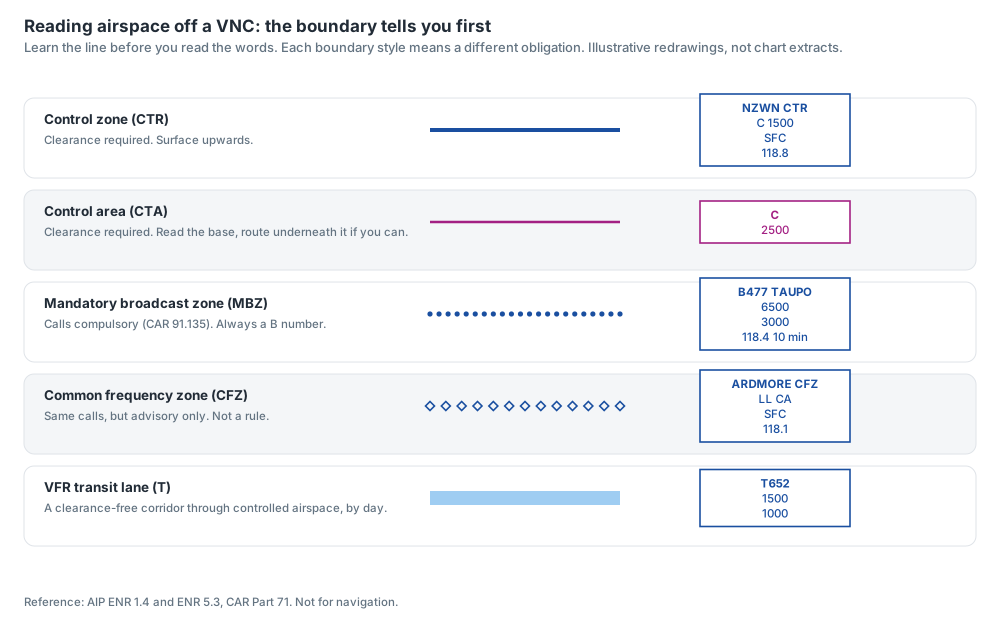
Illustrative redrawings of the boundary styles and label-box grammar. Not chart extracts, and not for navigation.
The letter prefixes on special use areas are a quick index. R restricted, D danger, M military operating area, B mandatory broadcast zone, V volcanic hazard zone, T VFR transit lane. R and M need approval, D needs your judgement, B needs broadcasts, and T is a clearance-free corridor by day.
For cross-country work the primary chart is the VNC, supported by the VFR planning chart for the big picture and, around busy aerodromes, the larger-scale visual terminal chart where the airspace is too crowded to show clearly at VNC scale.
Loading simulation
Vertical limits, the bit that catches people
Controlled airspace is three-dimensional, and the chart gives you a floor and a ceiling against each area. The number people misread is the floor.
Always read both figures. It is the floor of a CTA step that tells you whether you can legally route underneath it without a clearance, and the top of a transit lane that tells you how high you may climb before you bust into controlled airspace. A control zone's floor is always the surface. Levels are AMSL unless stated otherwise.
That last point has a practical edge. AMSL means your altimeter setting and the terrain underneath both matter when you are planning to stay below a floor. A 2500 ft step with 1800 ft of hill under it leaves less usable air than the number suggests, and an altimeter set to the wrong QNH will quietly spend some of what is left.
While you are working the vertical limits, the VMC minima that apply in each class are the other half of the same planning question.
Loading simulation
A routine that makes airspace busts hard
Chart reading is where this module gets tested for real, on every flight as well as in the exam. The discipline is simple and it works.
Trace the track before you fly
Run your planned route across the chart and identify every airspace block it touches. Do not skip the ones you intend to pass near rather than through.
For each block, note three things
What it is, meaning CTR, CTA or a letter-coded special use area. Its class, meaning C, D or G. And its vertical limits, floor and ceiling, in feet AMSL.
Decide the action for each one
Clearance, approval, broadcast, or simply stay clear. Write it on the plan rather than leaving it to memory in the air.
Check the activation
Transit lanes are day only. GAAs may need notification or approval. MBZ frequencies and reporting intervals are published and specific to the zone.
Do that and a bust becomes very hard to commit, because you will have seen the boundary coming and already decided what to do about it.
Why understanding beats memorising
You could learn that Class D needs a clearance and move on. Plenty of students do, and they pass that question.
Then the exam asks what service you receive at the exact level where Class C sits on top of Class D, or whether you may enter a transit lane at last light, or why a CFZ call is good airmanship but not a legal requirement. None of those are recall questions. They come out of the two ideas at the top of this article, namely whether the airspace is controlled and how restrictive it is, plus knowing which document each obligation lives in.
More to the point, the same understanding is what stops you climbing through the top of a transit lane on a clear day because the air above it looked empty. It was empty. It was also Class C.
Try some real exam questions on airspace, free and with full explanations, and see which of these you already have. For the full syllabus, our NZ PPL Air Law course teaches airspace alongside the rest of the rules you are examined on.
Sources and further reading
- AIP New Zealand ENR 1.4, airspace classification and the less-restrictive-class boundary rule
- AIP New Zealand ENR 5.3, mandatory broadcast zones and common frequency zones
- AIP New Zealand ENR 5.5, VFR transit lanes
- Civil Aviation Rules Part 71, Designation and Classification of Airspace
- Civil Aviation Rules Part 91, General Operating and Flight Rules, including 91.131, 91.135 and 91.139
Frequently asked questions
What classes of airspace does New Zealand use?
Four of the seven ICAO classes. Class A exists only as high-level oceanic airspace in the Auckland Oceanic area. The airspace you fly in as a VFR pilot is Class C and Class D, which are controlled and need an ATC clearance, and Class G, which is uncontrolled and needs no clearance. AIP ENR 1.4 states that Classes B, E and F are not currently used in New Zealand.
What is the difference between Class C and Class D airspace?
Both need an ATC clearance to enter and both allow VFR flight. In Class C, ATC separates IFR from IFR and IFR from VFR, and gives VFR flights traffic information about other VFR. In Class D, ATC separates IFR from IFR only and passes traffic information to VFR, so you remain responsible for seeing and avoiding other VFR traffic yourself.
What is the difference between a control zone and a control area?
A control zone, or CTR, extends upwards from the surface of the earth to a specified limit, so it reaches the ground and you need a clearance before you taxi onto the manoeuvring area. A control area, or CTA, extends upwards from a specified limit above the earth, so it has a floor aloft with clear air underneath. Successive control areas stepping up as they move away from an aerodrome are what create the inverted wedding cake shape.
What is the difference between an MBZ and a CFZ?
Obligation. In a mandatory broadcast zone, broadcasts are a legal requirement under CAR 91.135, and you must also maintain a listening watch and use landing or anti-collision lights if fitted. In a common frequency zone, AIP ENR 5.3 describes the same calls as encouraged but explicitly not mandatory and advisory in nature. Same intent, same calls, only the MBZ carries the force of a rule.
Can I fly through controlled airspace without a clearance?
Through a VFR transit lane, yes. AIP ENR 5.5 describes a transit lane as part of a CTR or CTA released as Class G airspace during daylight hours only, and while it is active a VFR aircraft may enter and operate within it without a clearance or reference to ATC. You must stay inside its lateral boundaries and below its published vertical limit, because exceeding either puts you back in controlled airspace.