Converting an Overseas Pilot Licence to a New Zealand One
By Pilot Prep

If you hold an overseas licence and you are moving to New Zealand, there is one sentence in the CAA's guidance that everybody quotes at you.
"CAANZ does not recognise overseas examination credits in isolation."
From that, a lot of people conclude they will have to re-sit the entire New Zealand theory syllabus. For most licence holders that is wrong, and it is wrong in a way that costs people months of unnecessary study.
Here is what you actually have to sit, according to the CAA's own recognition guidance, which was revised in September 2026.
The short version
For a New Zealand PPL, if your overseas licence is current and unrestricted, you sit no New Zealand written examinations at all.
For a New Zealand CPL, you sit one, and it is Air Law.
The catch is in the word "current", and in a commercial experience requirement that decides which of two very different routes you are on.
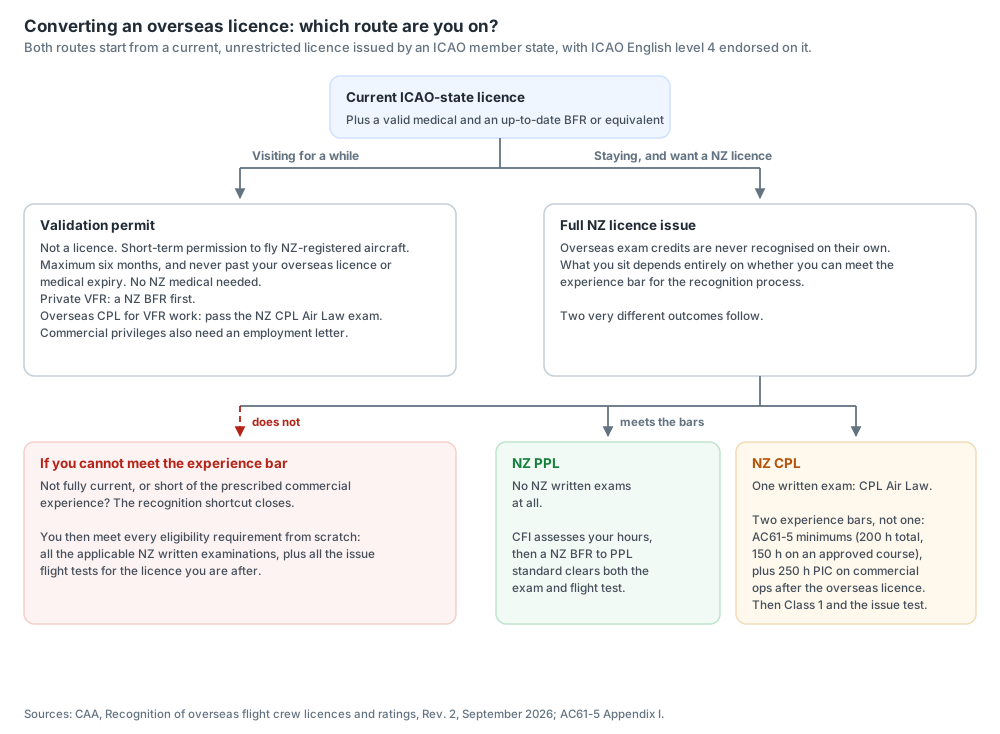
Both routes start from a current, unrestricted licence issued by an ICAO member state.
Are you converting, or just visiting?
These are two different documents and people conflate them constantly.
A validation permit is not a pilot licence. It is a short-term document that lets you exercise your overseas licence privileges in New Zealand registered aircraft. It has a maximum validity of six months, and it will never extend past the expiry of your overseas licence or medical, whichever comes first.
What makes it attractive is what it does not require. There is no New Zealand medical examination, because you fly on your existing overseas medical certification. For private VFR flying, the prerequisite is a New Zealand Biennial Flight Review.
What it does require, if you hold an overseas CPL and want to fly VFR in New Zealand airspace, is a pass in the New Zealand CPL Air Law written examination. Add an instrument rating and IFR intentions, and you need the Instrument Rating Air Law examination as well. ATPL privileges need the ATPL Air Law examination.
There are two carve-outs worth knowing. Ferry flights out of New Zealand in New Zealand registered aircraft, and specific approved tasks such as flying at an air show or flight testing where no suitable New Zealand applicant exists, do not require a New Zealand Air Law examination at all.
A validation permit is not renewable, but you can apply for a new one. If less than five years have passed since you gained your New Zealand Air Law credit, you will not have to re-sit it.
Commercial privileges on a validation permit also need a letter from the certificated New Zealand organisation confirming your employment.
A validation permit is a short-term permission, not a licence. Maximum six months, no New Zealand medical needed, and a New Zealand BFR is the prerequisite for private VFR. An overseas CPL flying VFR needs the NZ CPL Air Law examination.
Converting to a New Zealand PPL
This is the route that surprises people.
If you hold a current, unrestricted PPL or higher issued by an ICAO member state, you do not sit New Zealand written examinations. The process runs through a flight training organisation instead.
Take your paperwork to a CFI
Produce your current overseas licence, current medical certification and pilot logbook to the Chief Flying Instructor for a flight experience assessment.
Meet the NZ PPL experience minimums
Your logged experience has to satisfy the minimum flight experience prescribed in AC61-3. Two specific items catch people out, namely the dual instrument instruction requirement and the PPL weather and terrain awareness requirement.
Complete a NZ Biennial Flight Review to PPL standard
This is the step that does the work. The CAA states that successfully completing a NZ BFR to PPL standard fulfils both the examination and the flight test requirements for a PPL issued to a current overseas licence holder.
Apply to the CAA
Submit through the MyAviation online portal, or on the Part 61 overseas licence holder form, with your payment receipt, the CAA 24FPP or 24FPPDEC form including criminal and driving records, a copy of your certified BFR, and copies of your overseas licence, medical and flight experience assessment.
The BFR is not a formality. Its flight phase is conducted against the PPL Flight Test Standards Guide, and it must include a comprehensive briefing covering all the appropriate aspects of VFR operations in New Zealand airspace.
That briefing is the part worth preparing for properly. New Zealand airspace has features that will be unfamiliar coming from most other systems, including mandatory broadcast zones, common frequency zones, VFR transit lanes and the way control area steps are drawn and labelled. Our guide to New Zealand airspace classes and reading a VNC covers the ground that briefing will cover.
Two limitations can follow you through. If you do not meet the New Zealand PPL night flight minimum times, your logbook is endorsed to say PPL privileges may not be exercised at night. If you have not met the dual instrument instruction or weather and terrain awareness requirements, you are not eligible for the licence until you do, and that time can be completed in New Zealand.
On medicals, once you hold the New Zealand PPL you may fly on your existing overseas medical certification, but only until the expiry date shown on it at the time you entered the New Zealand system. After that you need a CAANZ Class 2 or a DL9.
Converting to a New Zealand CPL
Here the assessment is done by Aspeq rather than a flight training organisation, and there are two separate experience bars. They get confused constantly, so it is worth separating them properly.
The first is the ordinary New Zealand CPL minimum, which every CPL holder has to meet however they got there. AC61-5 Appendix I sets it at 200 hours total in aeroplanes, or 150 hours if you completed a full course of approved training. Inside that total sit 100 hours pilot in command, 30 hours cross-country navigation, 10 hours night and 10 hours instrument time.
The second applies only to this recognition route. To qualify for the examination exemption, you also need evidence of at least 250 hours as pilot in command on commercial operations, gained after the issue of the overseas licence you are presenting, and gained in countries under the jurisdiction of the authority that issued it.
So the 250 is not the total-time requirement and it does not replace the 200. It is an additional bar, and it is specifically commercial pilot in command time flown on the strength of the licence you are converting. That is the price of not sitting the full set of New Zealand written examinations.
Clear both, and Aspeq writes to you with your personal conversion requirements. In most cases that means:
- A CAANZ Class 1 Medical Certificate
- A pass in the New Zealand CPL Air Law written examination
- A CPL issue flight test with an Aspeq examiner
One written examination. Not six.
For an ATPL the shape is the same with bigger numbers. The recognition gate is 500 hours as pilot in command or 1000 hours as co-pilot on multi-crew, multi-engine, commercial IFR operations, on top of the AC61-7 minimums for the licence itself. Then a Class 1 medical, the ATPL Air Law examination, and an ATPL issue flight test. Every ATPL issued includes a New Zealand Instrument Rating.
The route nobody wants
Now the exception, and it is the reason that "no exam credits in isolation" line exists.
If your overseas licence is not fully current, or you cannot produce the prescribed commercial experience, the recognition shortcut closes entirely. The CAA is explicit about what happens then. You must meet every eligibility requirement prescribed for the issue of a New Zealand PPL, CPL or ATPL, and that includes passing all the applicable New Zealand examinations and all the issue flight tests.
There is one named special case. CAANZ does not recognise the UK Basic CPL-A or CPL(A)(R) for New Zealand CPL equivalence. Holders of those must pass all the New Zealand CPL written examinations and complete both a CPL cross-country flight test and a CPL issue flight test.
| NZ PPL | NZ CPL | Cannot meet the bar | |
|---|---|---|---|
| NZ written exams | None | CPL Air Law only | All applicable exams |
| Assessed by | Flight training organisation CFI | Aspeq | Normal eligibility route |
| Experience gate | AC61-3 minimums | AC61-5 minimums (200 h total, or 150 h on an approved course) plus 250 h PIC on commercial operations | Full syllabus requirements |
| Flight test | NZ BFR to PPL standard | CPL issue test with an Aspeq examiner | All issue flight tests |
| Medical | Overseas until expiry, then Class 2 or DL9 | CAANZ Class 1 | As required for the licence |
What carries over, and what does not
Your logged hours transfer, but not uniformly, and the detail matters when you are planning a CPL or an instrument rating.
Overseas flight time only counts towards New Zealand totals once a valid overseas licence has been presented for conversion.
For a CPL, overseas cross-country hours count towards the 30 hour CPL(A) or 20 hour CPL(H) cross-country requirement, but not towards the specific 20 hour aeroplane or 16 hour helicopter syllabus requirement, and the cross-country flight test is still required. Pilot in command time flown overseas counts towards the 100 hour aeroplane or 35 hour helicopter CPL issue requirement, but not towards any specific flight experience requirement beyond PPL issue.
For an instrument rating, overseas VFR cross-country pilot in command experience counts towards the 50 hour requirement provided at least 10 of those hours are in the appropriate category. The 10 hours of dual instrument cross-country under an IFR plan must be flown in New Zealand.
Two things are simply not recognised. Overseas Instrument Ground Time does not count towards the instrument requirements, only actual Instrument Flight Time does. And PICUS hours are not recognised in New Zealand at all, either for conversion or towards any experience requirement.
New Zealand also does not issue a night VFR rating. Your licence is restricted to day only until you meet the night training and competency requirements, which means a logbook assessment by a Category A or B instructor, a verbal assessment of New Zealand night flying rules, and a competency demonstration flight.
The part everyone forgets
Every route above requires ICAO English Language Proficiency at level 4 or better, endorsed on your overseas licence. If you do not hold the endorsement, you complete the ELP test in New Zealand.
And whichever route you are on, the CAA needs criminal and driving records from any country you have lived in for a continuous period of more than six months in the last five years. Start collecting those early, because they are usually the slowest item in the file.
The bottom line
The blanket claim that converts have to re-sit everything is only true for pilots who fall outside the recognition process, either because their licence is not current or because they cannot show the commercial experience.
Inside it, a PPL holder sits nothing and a CPL holder sits Air Law. The real work is the flight assessment, the New Zealand airspace briefing, and the paperwork.
Air Law is also the one subject where a conversion genuinely cannot lean on what you already know, because the rules are specific to New Zealand. If that is the exam standing between you and a New Zealand CPL, our air law course teaches it against the CAA rules rather than as a list to memorise, and you can try the questions free first.
Finally, a caveat that matters. This is a guide to how the recognition process is structured, not advice on your file. Requirements change, and Aspeq issues each applicant a personal letter setting out their own conversion requirements. Check the current CAA guidance before you commit to anything.
Sources and further reading
- CAA, Recognition of overseas flight crew licences and ratings, Revision 2, September 2026
- CAA, Recognising foreign pilot licences
- CAA, AC61-3 Pilot licences and ratings, Private pilot licence
- CAA, AC61-5 Pilot licences and ratings, Commercial pilot licence, Appendix I sets the 200 hour CPL(A) minimum
- Aspeq, which administers the New Zealand written examinations and the initial issue flight tests
Frequently asked questions
Do I have to re-sit all the New Zealand exams to convert my licence?
Usually not. If you hold a current, unrestricted licence from an ICAO member state, a New Zealand PPL requires no New Zealand written examinations at all, and a New Zealand CPL requires only the CPL Air Law examination. You must sit all the applicable examinations only if your licence is not fully current, or you cannot meet the prescribed commercial experience for the recognition process.
What do I need for a New Zealand PPL as an overseas licence holder?
Produce your current overseas licence, medical certification and logbook to a Chief Flying Instructor for a flight experience assessment against the AC61-3 minimums, then complete a New Zealand Biennial Flight Review to PPL standard with a Category A or B instructor. The CAA states that successfully completing that BFR fulfils both the examination and flight test requirements. The BFR must include a comprehensive briefing on VFR operations in New Zealand airspace.
What do I need for a New Zealand CPL?
Two separate experience bars, which are easy to confuse. First the ordinary New Zealand CPL minimum from AC61-5 Appendix I, which is 200 hours total in aeroplanes, or 150 hours if you completed a full course of approved training, including 100 hours pilot in command, 30 hours cross-country, 10 hours night and 10 hours instrument. Second, and only for the recognition route, evidence of at least 250 hours as pilot in command on commercial operations gained after the issue of the licence you are presenting. The 250 does not replace the 200, it is an additional bar and it is what earns the exemption from sitting all the written examinations. Clear both and Aspeq writes to you with your requirements, usually a CAANZ Class 1 Medical Certificate, a pass in the New Zealand CPL Air Law written examination, and a CPL issue flight test with an Aspeq examiner.
What is a validation permit and how is it different?
A validation permit is not a licence. It is a short-term document, valid for a maximum of six months and never beyond your overseas licence or medical expiry, that lets you exercise your overseas privileges in New Zealand registered aircraft. It needs no New Zealand medical. A New Zealand BFR is the prerequisite for private VFR flying, and an overseas CPL holder flying VFR must pass the New Zealand CPL Air Law examination.
Do my overseas flying hours count towards a New Zealand licence?
Partly, and only once a valid overseas licence has been presented for conversion. Overseas cross-country hours count towards the 30 hour CPL(A) cross-country requirement but not the specific 20 hour syllabus requirement, and the cross-country flight test is still required. Only actual Instrument Flight Time counts towards instrument requirements, not Instrument Ground Time. PICUS hours are not recognised in New Zealand at all.